What Is a Simile in Nature?
A simile is a figure of speech that compares two different things using the words “like” or “as.” In nature writing, similes compare natural features, weather, plants, animals, and landscapes with familiar objects, feelings, or experiences.
For example:
The river shone like a ribbon of glass. This compares the river’s smooth, reflective surface to glass.
The wind was as gentle as a mother’s touch. This describes a soft breeze as comforting and tender.
The clouds drifted like ships across the sky. This helps readers imagine clouds moving slowly through the atmosphere.
A simile differs from a metaphor because a simile makes an explicit comparison using “like” or “as,” while a metaphor describes one thing as another.
Quick Answer: Best Similes for Nature
Here are 15 memorable similes you can use in poems, essays, stories, and descriptive writing.
Nature simile | Meaning |
|---|---|
The forest was as quiet as a sleeping baby. | The forest was peaceful and still. |
The river sparkled like liquid silver. | Sunlight reflected brightly on the water. |
The clouds floated like cotton balls. | The clouds looked soft and fluffy. |
The wind whispered like a secret friend. | The breeze made a gentle, soothing sound. |
The sun shone like a golden coin. | The sun looked bright and round. |
The mountains stood like ancient giants. | The mountains appeared enormous and powerful. |
The rain fell like silver threads. | The rain looked like fine, shining lines. |
The flowers danced like ballerinas. | The flowers swayed gracefully in the breeze. |
The ocean roared like a hungry lion. | The waves sounded fierce and powerful. |
The stars glittered like diamonds. | The stars appeared bright in the night sky. |
The leaves trembled like frightened birds. | The leaves shook in the wind. |
The meadow was as colorful as a painter’s palette. | The meadow contained many vivid colors. |
The snow covered the ground like a white blanket. | The snow spread across the landscape. |
The waterfall thundered like a drum. | The falling water produced a loud, powerful sound. |
The morning dew shone like tiny crystals. | Water droplets glittered in the early light. |
Similes for Trees and Forests
Trees and forests create some of the most powerful images in nature writing. They can suggest peace, mystery, strength, age, or loneliness. Use these similes when describing woodlands, gardens, parks, or wilderness scenes.
Simile | Meaning and explanation |
|---|---|
The trees stood like silent guardians. | The trees seemed to protect the forest. |
The forest was as dark as a forgotten cave. | The thick trees blocked much of the light. |
The branches stretched like long, bony fingers. | Bare branches reached in different directions. |
The old oak was as strong as an iron tower. | The tree appeared sturdy and resilient. |
The leaves fluttered like green butterflies. | The leaves moved lightly in the breeze. |
The forest floor was like a patchwork quilt. | Fallen leaves, moss, and plants formed a varied pattern. |
The pine trees stood like soldiers on duty. | The trees appeared upright and orderly. |
The moss felt as soft as velvet. | The moss had a smooth, soft texture. |
The autumn trees blazed like torches. | Their orange and red leaves appeared brilliantly bright. |
The woodland was as peaceful as a sleeping village. | The forest felt calm and undisturbed. |
Example in a sentence: The ancient forest stood like a gathering of wise elders, its twisted branches holding stories from a thousand storms.
Similes for Flowers, Plants, and Gardens
Flowers and plants are excellent subjects for similes because they offer vivid colors, delicate textures, and graceful movements. These comparisons work well in spring poems, garden descriptions, greeting cards, and school essays.
Simile | Meaning and explanation |
|---|---|
The roses were as red as rubies. | The roses had a deep red color. |
The daisies dotted the grass like stars in the sky. | White flowers stood out across the green field. |
The sunflower stood like a golden crown. | Its bright petals formed a crown-like shape. |
The vines curled like sleeping snakes. | The vines twisted and wound around surfaces. |
The petals were as delicate as tissue paper. | The petals seemed thin and fragile. |
The wildflowers spread like a colorful carpet. | Flowers covered a large area of ground. |
The tulips nodded like polite guests. | Their stems bent gently in the breeze. |
The cactus was as prickly as a hedgehog. | The cactus had sharp protective spines. |
The ivy clung to the wall like a determined climber. | The ivy held firmly to the surface. |
The fresh shoots rose like tiny green flames. | New growth appeared upright and bright. |
Example in a sentence: After weeks of rain, the garden bloomed like a living rainbow, filling the yard with color and fragrance.
Similes for the Sun and Sunshine
The sun can represent warmth, happiness, hope, energy, or even unbearable heat. The best simile depends on the atmosphere you want to create.
Simile | Meaning and explanation |
|---|---|
The sun was as bright as a diamond. | The sunlight appeared dazzling. |
The morning sun rose like a golden ball. | The sun appeared round and golden at sunrise. |
Sunlight spilled like honey across the fields. | Warm light spread slowly over the landscape. |
The afternoon sun burned like a furnace. | The heat was intense and uncomfortable. |
The sun peeked through the clouds like a curious child. | The sun appeared briefly between clouds. |
The sunlight danced like gold on the water. | Reflections moved and shimmered on the surface. |
The sunset glowed like a bed of embers. | The horizon held deep orange and red colors. |
The sun warmed my face like a soft blanket. | The warmth felt comforting and gentle. |
The sun hung in the sky like a polished copper coin. | The sun looked round and copper-colored. |
The first rays stretched like golden fingers. | Narrow beams of sunlight reached across the land. |
Example in a sentence: As dawn broke, sunlight spilled like warm honey over the sleepy village, turning rooftops and fields a soft shade of gold.
Similes for the Moon, Stars, and Night Sky
Nighttime nature descriptions often benefit from similes that create a sense of wonder, mystery, calm, or distance.
Simile | Meaning and explanation |
|---|---|
The moon shone like a silver lantern. | The moon illuminated the darkness. |
The stars sparkled like scattered diamonds. | Numerous stars appeared bright and glittering. |
The night sky was as dark as ink. | The sky looked almost completely black. |
The crescent moon curved like a silver hook. | The moon had a thin, curved shape. |
The Milky Way stretched like a river of light. | The band of stars looked like a luminous stream. |
The stars twinkled like tiny candles. | The stars appeared to flicker gently. |
The full moon hung like a pearl in the sky. | The moon looked round, pale, and luminous. |
The clouds drifted like ghosts through the moonlight. | The clouds moved softly in an eerie atmosphere. |
The horizon glowed like a fading fire. | The last light of dusk remained in the distance. |
The night was as still as a sleeping cat. | The surroundings felt quiet and motionless. |
Example in a sentence: Beneath the velvet darkness, the stars glittered like scattered diamonds, while the moon watched over the sleeping countryside.
Similes for Rain and Raindrops
Rain can feel refreshing, romantic, gloomy, or frightening. Similes help distinguish a soft drizzle from a violent downpour.
Simile | Meaning and explanation |
|---|---|
The rain fell like a curtain of beads. | Raindrops formed a dense, visible sheet. |
The drizzle was as gentle as a lullaby. | The rain was soft and soothing. |
The raindrops tapped like impatient fingers on the roof. | Rain made repeated tapping sounds. |
The storm poured like a waterfall from the sky. | Heavy rain fell continuously. |
The droplets shone like tiny diamonds on the grass. | Water glistened in the light. |
The rain swept across the fields like a traveling army. | Wind-driven rain moved forcefully across the land. |
The puddles spread like little mirrors. | The water reflected the surroundings. |
The rain smelled as fresh as a newly opened garden. | The air smelled clean and earthy after rainfall. |
The hail struck the roof like handfuls of pebbles. | Hailstones made hard, sharp impacts. |
The rain faded like a song growing distant. | The rainfall gradually became quieter and lighter. |
Example in a sentence: Rain pattered against the window like a thousand tiny drummers, turning the dusty road into a ribbon of glistening mud.
Similes for Wind and Breezes
Wind is invisible, but its effects are easy to observe. It bends trees, carries scents, moves clouds, and changes the mood of a landscape.
Simile | Meaning and explanation |
|---|---|
The breeze was as gentle as a whisper. | The wind was soft and quiet. |
The wind howled like a hungry wolf. | The wind made a loud, eerie sound. |
The gusts hit the trees like angry waves. | Powerful gusts shook the branches. |
The breeze brushed my cheek like a feather. | The wind felt light and delicate. |
The wind raced through the valley like a wild horse. | The wind moved quickly and freely. |
The leaves rustled like pages turning in a book. | Moving leaves made a soft, papery sound. |
The storm wind was as fierce as a charging bull. | The wind felt forceful and dangerous. |
The breeze carried the scent of flowers like a perfumed messenger. | The wind spread floral fragrances. |
The wind twisted through the grass like a playful child. | The grass bent in changing directions. |
The cold wind bit like icy needles. | The wind felt sharply cold against the skin. |
Example in a sentence: A cool breeze drifted through the orchard like a gentle visitor, carrying the sweet scent of ripe apples.
Similes for Rivers, Lakes, and Waterfalls
Water can be still as glass, restless as a crowd, or powerful as a moving wall. These similes are useful for describing rivers, ponds, streams, lakes, and waterfalls.
Simile | Meaning and explanation |
|---|---|
The lake was as smooth as glass. | The water was calm and nearly motionless. |
The stream wound like a silver ribbon. | The stream curved through the landscape. |
The waterfall roared like a giant engine. | The falling water produced a powerful noise. |
The river moved like a restless snake. | The river twisted and turned along its course. |
The pond reflected the sky like a polished mirror. | The water showed a clear reflection. |
The waves slapped the shore like impatient hands. | The water struck the shoreline repeatedly. |
The brook sang like a cheerful bird. | The flowing water made a pleasant, light sound. |
The water was as clear as crystal. | The water appeared transparent and clean. |
The current rushed like a speeding train. | The water moved with great force and speed. |
The ripples spread like rings on a sheet of silk. | Small waves traveled smoothly across the surface. |
Example in a sentence: The mountain stream twisted through the rocks like a silver ribbon, its clear water singing over stones polished by time.
Similes for the Ocean and Sea
The sea can feel peaceful and inviting or enormous and intimidating. Choose a simile that matches the weather, movement, and mood of the scene.
Simile | Meaning and explanation |
|---|---|
The ocean was as blue as a sapphire. | The water appeared intensely blue. |
The waves crashed like thunder. | The waves made a deep, powerful sound. |
The sea stretched like an endless blue blanket. | The ocean appeared vast and continuous. |
The tide crept in like a quiet visitor. | The water advanced gradually along the shore. |
The waves curled like giant fingers. | The water formed curved shapes before breaking. |
The sea glittered like a field of diamonds. | Sunlight sparkled across the water. |
The stormy ocean was as wild as a runaway horse. | The waves were rough and uncontrolled. |
The foam spread like lace along the shore. | White sea foam formed delicate patterns. |
The waves rolled like hills in motion. | The sea rose and fell in large swells. |
The ocean breeze tasted as salty as a tear. | The air carried a strong salty sensation. |
Example in a sentence: Under the evening sun, the ocean glittered like a field of diamonds, while white foam traced delicate patterns along the sand.
Similes for Mountains, Hills, and Valleys
Mountains and valleys provide a sense of scale. Similes can emphasize their grandeur, their stillness, their rugged surfaces, or their changing colors.
Simile | Meaning and explanation |
|---|---|
The mountains rose like sleeping giants. | The peaks looked enormous and still. |
The hills rolled like waves across the countryside. | The landscape contained repeated, rounded slopes. |
The valley was as green as an emerald. | The vegetation appeared richly green. |
The cliffs stood like walls of stone. | The rock faces appeared steep and solid. |
The mountain peaks glittered like broken glass in sunlight. | Sunlight reflected sharply off rocky or icy surfaces. |
The mist wrapped the hills like a woolen shawl. | Fog covered the slopes softly. |
The rocky path was as rough as sandpaper. | The trail had an uneven, abrasive surface. |
The mountain shadow spread like a dark blanket. | A large shadow covered the lower landscape. |
The ridge cut across the horizon like a jagged saw. | The mountain outline had sharp peaks and dips. |
The valley lay as peacefully as a sleeping child. | The landscape felt sheltered and quiet. |
Example in a sentence: At sunrise, the mountain peaks glowed like crowns of fire, while mist wrapped the valley like a soft gray shawl.
Similes for Clouds, Sky, and Weather
The sky changes constantly, making it a rich source of imagery. Fluffy clouds, dark storm fronts, pale horizons, and colorful sunsets each suggest different comparisons.
Simile | Meaning and explanation |
|---|---|
The clouds were as fluffy as cotton. | The clouds looked soft and rounded. |
The storm clouds gathered like a dark army. | Heavy clouds collected ominously. |
The sky was as blue as a peacock’s feather. | The sky appeared richly blue. |
The clouds stretched like brushstrokes across the sky. | The clouds formed long, artistic shapes. |
The fog rolled in like a silent thief. | The fog appeared gradually and obscured the view. |
The rainbow arched like a colorful bridge. | The rainbow formed a curved band across the sky. |
The sunset blazed like a furnace. | The sky glowed with intense warm colors. |
The morning sky was as pale as a pearl. | The sky had a soft, light glow. |
Lightning flashed like a camera in the darkness. | Lightning appeared as a sudden burst of light. |
The thunder boomed like a giant’s drum. | Thunder made a loud, deep sound. |
Example in a sentence: Dark clouds gathered like a marching army, and the first flash of lightning split the sky like a blade of white fire.
Similes for Grass, Fields, and Meadows
Grasslands and meadows are ideal for describing movement, texture, color, and the quiet beauty of open spaces.
Simile | Meaning and explanation |
|---|---|
The grass was as green as jade. | The grass had a rich green color. |
The meadow swayed like an ocean of green. | The wind moved the grass in waves. |
The wheat shone like gold in the sunlight. | The ripe crop had a golden appearance. |
The grass felt as soft as a feather pillow. | The grass felt gentle underfoot. |
The tall grass whispered like a crowd sharing secrets. | The moving grass produced a faint rustling sound. |
The field stretched like a green carpet. | The field covered a broad area. |
The dew sparkled like tiny glass beads. | Water droplets reflected the morning light. |
The reeds bent like dancers in the wind. | The tall plants swayed gracefully. |
The wild meadow was as colorful as a box of crayons. | The meadow contained flowers of many colors. |
The dry grass crackled like old paper. | The brittle grass made a crisp sound. |
Example in a sentence: The meadow rolled like an ocean of green, its tall grasses bowing and rising with every passing breeze.
Similes for Animals and Wildlife in Nature
Animals bring movement and personality to natural descriptions. Comparing their actions with familiar experiences can help readers picture wildlife without lengthy explanations.
Simile | Meaning and explanation |
|---|---|
The deer moved as quietly as falling snow. | The deer walked almost silently. |
The eagle soared like a king above the mountains. | The eagle flew high and appeared majestic. |
The rabbit was as quick as lightning. | The rabbit moved very fast. |
The owl watched like a silent guardian. | The owl remained still and observant. |
The fish darted like silver arrows. | The fish moved quickly through the water. |
The butterfly floated like a scrap of colored silk. | The butterfly moved lightly through the air. |
The ants marched like a tiny army. | The ants moved in an organized line. |
The fox slipped through the bushes like a shadow. | The fox moved quietly and discreetly. |
The frogs croaked like rusty hinges. | The frogs made rough, repetitive sounds. |
The bees buzzed like miniature engines. | The bees produced a continuous humming sound. |
Example in a sentence: A fox slipped through the undergrowth like a shadow, disappearing between the trees before the morning birds finished singing.
Similes for Spring, Summer, Autumn, and Winter
Each season has its own character. Spring suggests renewal, summer brings warmth, autumn offers rich colors, and winter often evokes stillness and cold.
Spring similes
Spring arrived like a cheerful guest. — Nature seemed to awaken happily.
New leaves appeared as fresh as emeralds. — Young foliage looked bright and green.
The garden blossomed like a painted canvas. — Flowers filled the garden with color.
Example: Spring spread through the valley like a wave of new life.
Summer similes
The afternoon was as hot as an oven. — The weather felt intensely hot.
The sun blazed like a golden torch. — The sunlight was strong and bright.
The fields shimmered like a sea of gold. — Dry grass or ripe crops reflected sunlight.
Example: Summer settled over the countryside like a warm, golden blanket.
Autumn similes
The leaves fell like golden rain. — Leaves drifted down from the trees.
The forest glowed like a burning sunset. — Red and orange foliage created vivid colors.
The morning air was as crisp as a fresh apple. — The air felt cool and refreshing.
Example: Autumn painted the hillside like an artist working with fire and gold.
Winter similes
The snow lay like a white quilt. — Snow covered the ground evenly.
The wind was as sharp as a knife. — The cold wind felt biting.
The frozen pond was smooth as polished glass. — The ice appeared flat and reflective.
Example: Winter wrapped the village like a blanket of silence and snow.
Short Similes for Nature
Need a quick comparison for a worksheet, caption, poem, or descriptive paragraph? These short similes are easy to remember and adapt.
Simile | Meaning |
|---|---|
Green as grass | Very green |
Bright as sunshine | Cheerful or radiant |
Cold as ice | Extremely cold |
Clear as crystal | Transparent or easy to see through |
Quiet as a forest | Very peaceful |
Wild as the wind | Unrestrained or unpredictable |
White as snow | Pure white |
Soft as moss | Gentle to the touch |
Golden as sunlight | Warm and golden in color |
Fast as a river | Moving quickly |
Dark as a storm cloud | Gloomy or threatening |
Fresh as morning dew | Clean and refreshing |
Still as a lake | Motionless |
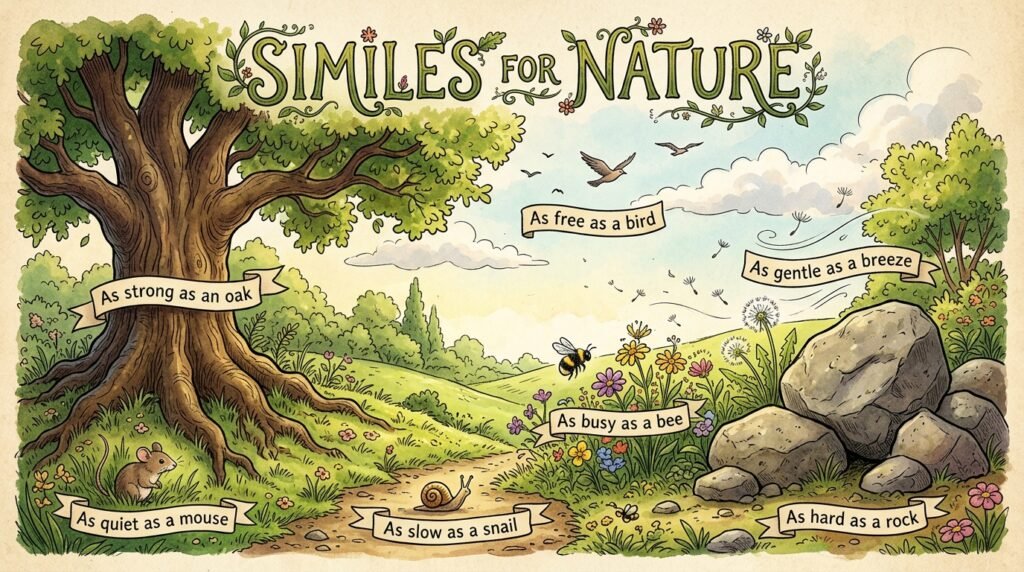
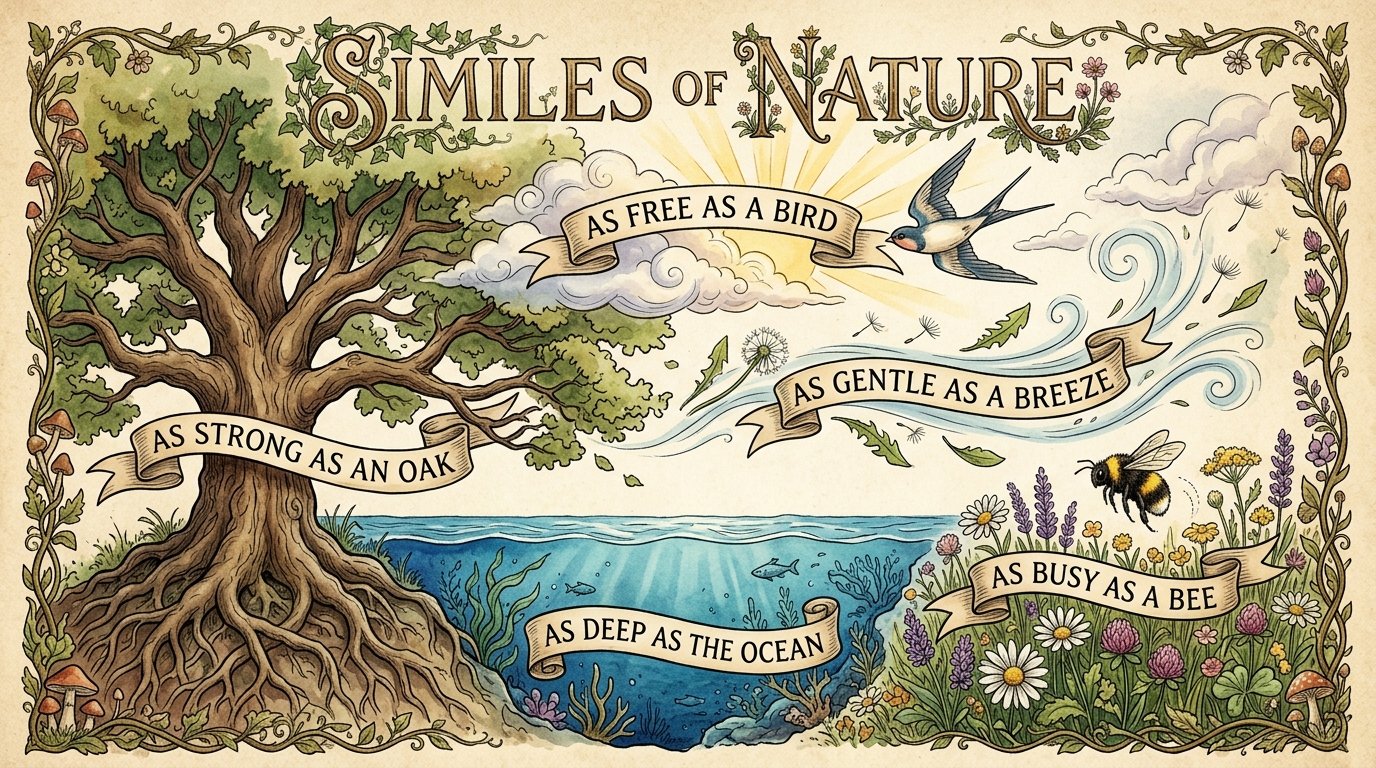
Strong as an oak | Powerful and resilient |
Free as a bird | Unrestricted and independent |
Colorful as a rainbow | Full of different colors |
Sharp as a thorn | Pointed or cutting |
Cool as a mountain breeze | Pleasantly cool |
Silent as falling snow | Almost completely quiet |
Deep as the ocean | Seemingly endless or profound |
These familiar comparisons are useful when you want a clear, concise description. For more original writing, adapt them to the particular scene rather than relying on the same expressions every time.
Creative and Unique Similes for Nature
Common comparisons are easy to understand, but fresh imagery can make a poem or story more memorable. The following original examples use unexpected comparisons to describe natural details.
Original simile | Meaning and explanation |
|---|---|
The morning mist curled around the trees like a secret trying not to be found. | Fog creates a mysterious atmosphere. |
The river stitched the valley like a silver thread through green fabric. | The river winds through a broad landscape. |
Moonlight rested on the leaves like dust from a fallen star. | Pale light creates a delicate, magical appearance. |
The meadow hummed like a sleepy orchestra. | Insects, birds, and rustling grass create a gentle chorus. |
The clouds crowded the horizon like unfinished thoughts. | A busy sky suggests uncertainty or tension. |
The bare branches reached upward like questions written against the sky. | The branches create a thoughtful, reflective image. |
Dew clung to the spiderweb like beads on a jeweler’s necklace. | Tiny droplets decorate the web. |
The waterfall spilled over the cliff like a secret too large to keep. | Water pours continuously and dramatically. |
The wind wandered through the wheat like a hand searching for a familiar face. | The moving wind bends the crop in gentle waves. |
The sunset faded like a letter written in disappearing ink. | The colors gradually vanish from the sky. |
The mountain stood against the dawn like a fortress guarding the horizon. | The mountain appears powerful and protective. |
The frost traced the window like delicate handwriting. | Ice forms intricate patterns on glass. |
The clouds floated above the peaks like thoughts escaping a dream. | The clouds move lightly through a mountain scene. |
The rain gathered on the petals like tiny promises of spring. | Droplets create a hopeful, fresh image. |
The reeds bowed beside the stream like listeners attending an ancient story. | The plants lean toward the flowing water. |
These examples work particularly well in creative writing because they do more than describe an object: they establish a mood and encourage readers to imagine a scene.
Similes for Nature for Students
Students often need similes that are simple enough to understand and easy to use in sentences. Here are ten classroom-friendly examples.
The sun is as bright as a light bulb. — The sun gives off strong light.
The river runs like a racehorse. — The river flows quickly.
The flowers are as colorful as a rainbow. — The flowers have many bright colors.
The clouds look like fluffy pillows. — The clouds appear soft and rounded.
The wind blows like a giant fan. — The wind moves air strongly.
The snow is as white as paper. — The snow appears bright white.
The tree is as tall as a tower. — The tree reaches great height.
The stars shine like tiny lamps. — The stars appear bright at night.
The leaves dance like little ballerinas. — The leaves move gracefully in the wind.
The thunder sounds like a giant banging a drum. — Thunder makes a loud, booming noise.
Writing tip for students: A simile does not have to be literally true. The comparison needs to communicate a clear image or feeling. For instance, clouds are not pillows, but comparing them to pillows helps readers imagine their fluffy appearance.
Similes for Nature in Poems and Descriptive Writing
A good nature simile does more than identify a resemblance. It helps create a mood, reveal a character’s feelings, or make a scene easier to imagine.
Consider these three approaches to describing the same natural setting.
The lake rested like a sleeping child beneath the morning sky.
This suggests calm, innocence, and stillness.
The fog crept through the forest like a stranger hiding its face.
This creates uncertainty and suspense.
The storm rushed across the plain like an army charging into battle.
This emphasizes speed, force, and danger.
How to write your own nature similes
Choose one natural feature. Start with a tree, cloud, flower, river, storm, or animal.
Notice its most distinctive quality. Is it bright, rough, quiet, graceful, fast, or powerful?
Find a familiar comparison. A cloud might resemble cotton, a sail, or a drifting thought.
Match the comparison to your intended mood. A gentle breeze suggests comfort, while a howling wind may suggest fear.
Read the sentence aloud. If the comparison feels confusing or distracts from the scene, simplify it.
For example, start with “The leaves moved in the wind.” Notice that they rise and fall in waves, then create a more vivid sentence: “The leaves rippled like green water beneath an invisible tide.”
Common Mistakes When Using Nature Similes
Similes can make writing vivid, but too many comparisons or poorly matched images can weaken a description.
Confusing similes with metaphors: “The river is a silver ribbon” is a metaphor; “The river shines like a silver ribbon” is a simile.
Choosing an unclear comparison: A comparison should help readers picture something rather than make them guess what it means.
Using too many similes in one sentence: One strong comparison often works better than several competing images.
Ignoring the mood: A playful comparison may not suit a frightening storm scene.
Repeating familiar phrases: “Bright as the sun” works, but a more specific image may be more memorable.
Forcing “like” or “as” into every description: A simile is a useful tool, not a requirement for every sentence.
The goal is not to decorate every line. It is to help the reader see, hear, feel, and imagine the natural world more clearly.