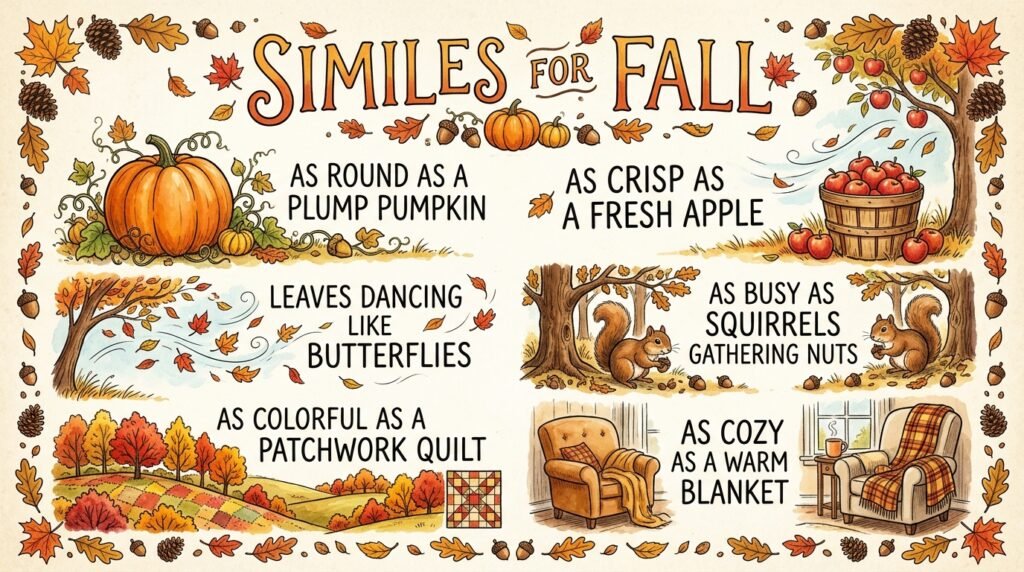
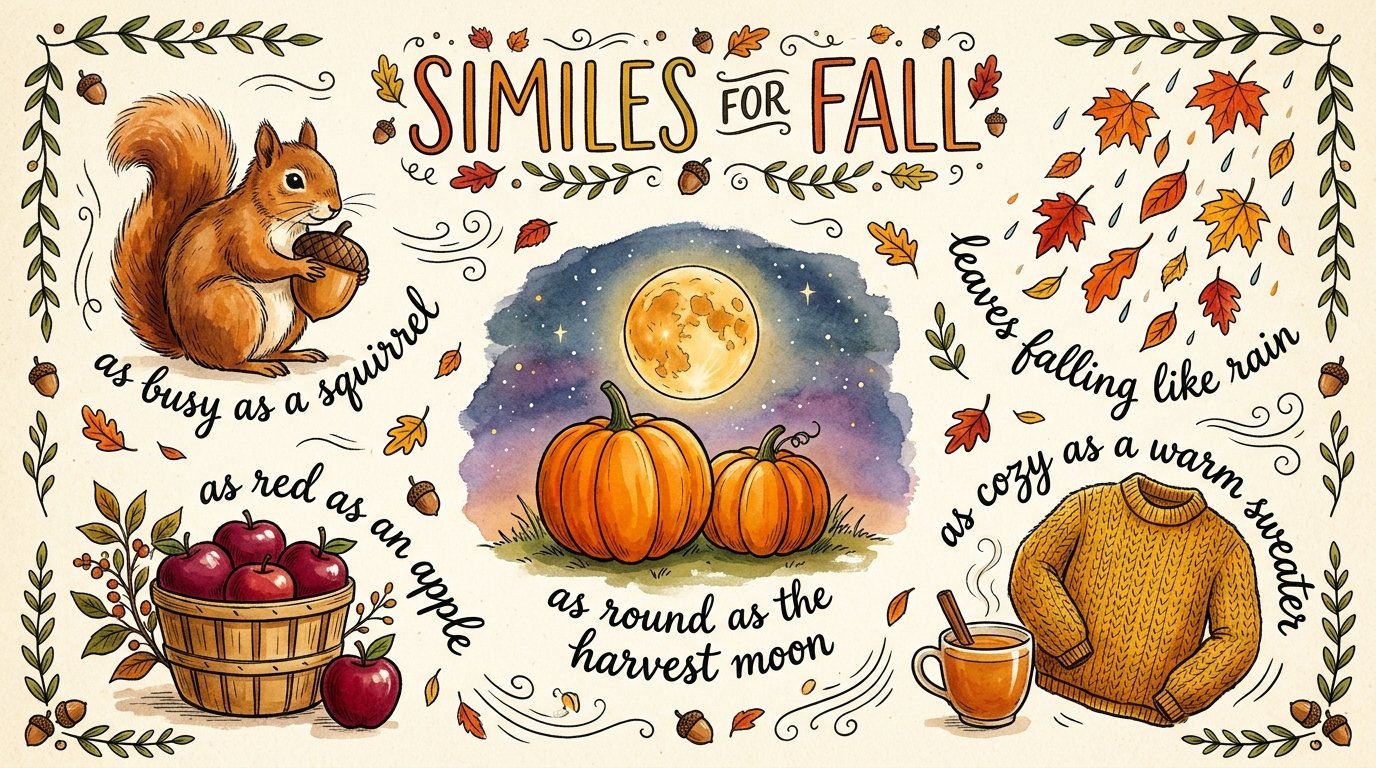
What Is a Simile for Fall?
A simile is a figure of speech that compares two different things using the words “like” or “as.” Writers use similes to help readers imagine the sights, sounds, feelings, and atmosphere of autumn.
For example:
The leaves danced like golden butterflies. This compares falling leaves to butterflies fluttering through the air.
The autumn morning was as crisp as a fresh apple. This describes the cool, refreshing feeling of fall weather.
The trees stood like guards dressed in gold. This creates an image of colorful trees lining a quiet road.
Similes can make fall descriptions poetic, funny, dramatic, or easy for young readers to understand.
Quick List: 20 Best Similes for Fall
Here are 20 expressive fall similes you can use in stories, essays, poems, and seasonal captions.
The leaves fluttered like butterflies.
Describes leaves drifting gently through the air.The trees blazed like bonfires.
Captures the brilliant red and orange foliage.The wind whispered like a secret.
Creates a quiet, mysterious autumn mood.The morning was as crisp as an apple.
Describes fresh, cool autumn air.The forest glowed like a golden kingdom.
Makes colorful woodland scenery feel magical.The leaves fell like confetti.
Suggests a lively shower of falling leaves.The moon shone like a silver coin.
Describes a bright autumn moon.The pumpkins sat like orange lanterns.
Creates a festive fall scene.The branches rattled like old bones.
Adds a spooky Halloween atmosphere.The fog crept like a silent ghost.
Describes mist moving mysteriously.The ground crunched like a bowl of chips.
Makes the sound of dry leaves playful.The sunset burned like a bed of embers.
Highlights deep orange and red evening skies.The rain tapped like tiny fingers.
Describes gentle autumn rain.The sweater felt as soft as a kitten.
Conveys the comfort of fall clothing.The leaves were as red as ripe cherries.
Emphasizes vivid red foliage.The breeze was like a cool kiss.
Makes the autumn wind feel gentle.The clouds drifted like gray ships.
Creates a picture of a cloudy fall sky.The pumpkin pie smelled like a warm hug.
Connects a seasonal scent with comfort.The scarecrow stood like a lonely soldier.
Gives a field a quiet, storybook mood.
The evening arrived like a sleepy cat.
Describes dusk settling softly.
Similes for Fall Leaves
Fall leaves are among the most recognizable symbols of autumn. Their changing colors, gentle movements, and crunchy textures offer plenty of inspiration for descriptive comparisons.
1. The leaves floated like feathers. — Suggests a soft, weightless fall. Example: Red leaves floated like feathers across the quiet garden.
2. The maple leaves shone like polished rubies. — Emphasizes their deep red color. Example: The maple leaves shone like polished rubies in the afternoon sun.
3. The leaves covered the path like a patchwork quilt. — Describes a colorful carpet of foliage. Example: Yellow, orange, and brown leaves covered the path like a patchwork quilt.
4. The dry leaves crackled like tiny campfires. — Focuses on the sound of brittle leaves. Example: Beneath our boots, the dry leaves crackled like tiny campfires.
5. The leaves swirled like dancers in a ballroom. — Creates a sense of graceful movement. Example: The leaves swirled like dancers in a ballroom when the wind picked up.
6. The oak leaves were as brown as melted chocolate. — Describes their rich brown color. Example: The oak leaves were as brown as melted chocolate after weeks of chilly weather.
7. The leaves drifted down like a slow-motion snowstorm. — Compares falling foliage to snow. Example: Golden leaves drifted down like a slow-motion snowstorm around the bench.
8. The leaves clung to the branches like tired travelers. — Suggests that the last leaves are reluctant to fall. Example: The final leaves clung to the branches like tired travelers waiting for shelter.
9. The autumn leaves sparkled like stained glass. — Highlights colorful leaves illuminated by sunlight. Example: The leaves sparkled like stained glass when the sun passed through them.
10. The leaves scattered like playing cards in the wind. — Describes leaves blown in different directions. Example: The leaves scattered like playing cards across the driveway.
Similes for Fall Weather
Autumn weather can shift from sunny and refreshing to chilly, rainy, and foggy. These similes help capture those changes.
11. The air was as fresh as a mountain stream. — Describes clean, refreshing air. Example: After the summer heat, the morning air was as fresh as a mountain stream.
12. The wind howled like a hungry wolf. — Creates a wild, dramatic atmosphere. Example: The wind howled like a hungry wolf around the corners of the house.
13. The rain fell like strings of silver beads. — Emphasizes the appearance of falling raindrops. Example: Autumn rain fell like strings of silver beads against the window.
14. The fog spread like a white blanket. — Describes mist covering the landscape. Example: The fog spread like a white blanket over the sleepy village.
15. The clouds hung like heavy gray curtains. — Suggests a gloomy, overcast sky. Example: Clouds hung like heavy gray curtains above the empty fields.
16. The chill crept in like an uninvited guest. — Describes cold weather arriving unexpectedly. Example: The chill crept in like an uninvited guest as the sun disappeared.
17. The autumn sun felt as gentle as a warm hand. — Captures mild sunshine on a cool day. Example: The autumn sun felt as gentle as a warm hand on my face.
18. The frost glittered like crushed diamonds. — Highlights sparkling frost on grass or leaves. Example: Early frost glittered like crushed diamonds across the lawn.
19. The thunder rumbled like a giant moving furniture. — Creates a playful, vivid sound comparison. Example: Thunder rumbled like a giant moving furniture above the darkened woods.
20. The breeze brushed my cheeks like a silk scarf. — Describes a light, soft wind. Example: The evening breeze brushed my cheeks like a silk scarf.
Similes for Fall Colors
Autumn’s reds, golds, oranges, and browns can turn ordinary landscapes into stunning scenes. Use these comparisons to bring seasonal colors to life.
21. The treetops were as golden as wedding rings. — Highlights bright yellow foliage. Example: The treetops were as golden as wedding rings in the morning light.
22. The hillside glowed like molten copper. — Describes a rich reddish-orange landscape. Example: At sunset, the hillside glowed like molten copper.
23. The red leaves burned like glowing coals. — Emphasizes intense red and scarlet shades. Example: Red leaves burned like glowing coals against the dark tree trunks.
24. The fields looked like blankets of caramel. — Captures warm golden-brown fields. Example: The harvested fields looked like blankets of caramel beneath the pale sky.
25. The sunset was as orange as a ripe persimmon. — Gives a clear image of a vivid orange sky. Example: The sunset was as orange as a ripe persimmon above the rooftops.
26. The forest shimmered like a sea of gold. — Describes broad stretches of golden trees. Example: The forest shimmered like a sea of gold whenever the wind stirred the branches.
27. The purple clouds looked like bruised plums. — Creates a moody image of dark violet clouds. Example: Purple clouds looked like bruised plums over the distant hills.
28. The garden was as colorful as a painter’s palette. — Emphasizes a mixture of autumn shades. Example: The garden was as colorful as a painter’s palette in October.
29. The brown grass looked like old parchment. — Suggests dry, faded grass. Example: The brown grass looked like old parchment beneath the leafless trees.
30. The horizon glimmered like a ribbon of fire. — Describes a bright band of sunset color. Example: The horizon glimmered like a ribbon of fire after the autumn rain.
Similes for Fall Trees and Forests
Trees change dramatically in fall. Their colorful crowns, bare branches, and rustling leaves can make a forest feel peaceful, mysterious, or magical.
31. The trees stood like soldiers guarding the road. — Suggests strength and order. Example: Tall trees stood like soldiers guarding the winding country road.
32. The branches stretched like bony fingers. — Creates a spooky image of bare branches. Example: The branches stretched like bony fingers against the moonlit sky.
33. The forest looked like a kingdom made of gold. — Gives autumn woods a magical quality. Example: The forest looked like a kingdom made of gold beneath the afternoon sun.
34. The old oak was as sturdy as a castle wall. — Emphasizes a tree’s strength and age. Example: The old oak was as sturdy as a castle wall despite the fierce wind.
35. The bare branches rattled like dry bones. — Describes the sound of branches moving in the wind. Example: Bare branches rattled like dry bones outside the cabin.
36. The pine trees stood like dark sentinels. — Creates a watchful, mysterious woodland scene. Example: The pine trees stood like dark sentinels around the golden clearing.
37. The falling leaves spiraled like tiny helicopters. — Describes leaves spinning as they descend. Example: Maple leaves spiraled like tiny helicopters toward the forest floor.
38. The woodland path wound like a brown ribbon. — Highlights a path curving through fallen leaves. Example: The woodland path wound like a brown ribbon between the trees.
39. The treetops swayed like a choir of dancers. — Suggests coordinated, graceful movement. Example: The treetops swayed like a choir of dancers in the autumn breeze.
40. The forest was as quiet as a sleeping village. — Creates a peaceful, still atmosphere. Example: After the birds flew south, the forest was as quiet as a sleeping village.
Similes for Fall Feelings and Cozy Moments
Fall is also a season of warm drinks, soft blankets, family gatherings, and comfortable evenings. These similes are ideal for personal essays, lifestyle blogs, and heartwarming stories.
41. The blanket felt like a hug from an old friend. — Expresses comfort and familiarity. Example: I wrapped myself in a thick blanket that felt like a hug from an old friend.
42. The hot chocolate was as comforting as a mother’s embrace. — Describes emotional warmth. Example: After a chilly walk, the hot chocolate was as comforting as a mother’s embrace.
43. The fireplace glowed like a little golden sun. — Highlights warmth and light indoors. Example: The fireplace glowed like a little golden sun in the corner of the room.
44. The cabin smelled like a bakery filled with cinnamon rolls. — Creates a warm, inviting scent image. Example: The cabin smelled like a bakery filled with cinnamon rolls as the pie baked.
45. The evening settled like a soft blanket. — Suggests a calm, gradual transition into night. Example: The evening settled like a soft blanket over the quiet neighborhood.
46. The tea warmed my hands like a pocket-sized heater. — Emphasizes the physical comfort of a hot drink. Example: My mug of tea warmed my hands like a pocket-sized heater.
47. The sweater was as cozy as a nest. — Describes snug, protective comfort. Example: My oversized sweater was as cozy as a nest on the chilly morning.
48. The candle flickered like a tiny dancing star. — Creates a delicate, peaceful image. Example: A candle flickered like a tiny dancing star beside the window.
49. The kitchen buzzed like a beehive before Thanksgiving. — Suggests busy, lively activity. Example: The kitchen buzzed like a beehive as everyone prepared the holiday meal.
50. The quiet afternoon felt like a long, gentle sigh. — Expresses relaxation and relief. Example: Reading beside the window, I felt the afternoon pass like a long, gentle sigh.
Funny Similes for Fall
Funny similes add personality to autumn descriptions. They’re especially useful for classroom activities, social media posts, lighthearted stories, and seasonal jokes.
51. The pumpkin was as round as a basketball in a sweater. — Makes a pumpkin sound amusingly dressed up. Example: Our porch pumpkin was as round as a basketball in a sweater.
52. The wind messed up my hair like an overexcited toddler. — Makes a bad-hair day relatable. Example: The autumn wind attacked my hairstyle like an overexcited toddler.
53. I jumped into the leaves like a puppy into a ball pit. — Captures enthusiastic excitement. Example: I jumped into the leaf pile like a puppy into a ball pit.
54. My scarf wrapped around me like a stubborn boa constrictor. — Describes a scarf that refuses to sit properly. Example: My oversized scarf wrapped around me like a stubborn boa constrictor.
55. The scarecrow looked as confused as a tourist without a map. — Gives a scarecrow a humorous personality. Example: The scarecrow looked as confused as a tourist without a map in the middle of the field.
56. The pumpkin pie disappeared like snacks at a movie night. — Suggests that a dessert was eaten quickly. Example: Grandma’s pumpkin pie disappeared like snacks at a movie night.
57. My cold nose was as red as a clown’s nose. — Exaggerates the effect of chilly weather. Example: After ten minutes outside, my nose was as red as a clown’s nose.
58. The leaves stuck to my shoes like unpaid bills. — Describes annoying leaves that follow you indoors. Example: Wet leaves stuck to my shoes like unpaid bills all the way home.
59. My dog chased leaves like a detective chasing a criminal. — Adds comic drama to a pet’s behavior. Example: My dog chased every blowing leaf like a detective chasing a criminal.
60. I wore so many layers that I waddled like a penguin. — Humorously describes bulky winter clothing. Example: Wrapped in coats and scarves, I waddled like a penguin to the bus stop.
Spooky Similes for Fall and Halloween
Autumn’s long shadows, dark evenings, and Halloween traditions make it perfect for eerie comparisons.
61. The fog crept like a ghost through the graveyard. — Creates an eerie, supernatural mood. Example: The fog crept like a ghost through the graveyard at midnight.
62. The old house stood like a monster waiting to wake. — Makes a building seem threatening. Example: At the end of the road, the old house stood like a monster waiting to wake.
63. The moon hung like a pale eye in the sky. — Gives the moon an unsettling appearance. Example: The moon hung like a pale eye above the abandoned barn.
64. The wind whistled like a witch’s laugh. — Adds a sinister sound to the night. Example: The wind whistled like a witch’s laugh through the broken fence.
65. The shadows stretched like long black claws. — Suggests danger or suspense. Example: The shadows stretched like long black claws across the hallway.
66. The pumpkin’s grin was as crooked as a pirate’s smile. — Gives a carved pumpkin a mischievous expression. Example: The pumpkin’s grin was as crooked as a pirate’s smile on Halloween night.
67. The cemetery was as silent as a forgotten dream. — Creates a haunting sense of stillness. Example: Under the autumn moon, the cemetery was as silent as a forgotten dream.
68. The owl’s call echoed like a warning bell. — Suggests that something mysterious may happen. Example: The owl’s call echoed like a warning bell through the woods.
69. The bare tree twisted like a giant’s crooked hand. — Makes a tree appear strange and frightening. Example: A bare tree twisted like a giant’s crooked hand beside the graveyard.
70. The night wrapped around the village like a dark cloak. — Describes darkness covering a place. Example: The night wrapped around the village like a dark cloak as the last lights faded.
Similes for Fall for Students and School Essays
These simple, easy-to-understand similes work well for elementary school assignments, creative writing, and descriptive paragraphs.
71. The leaves were as yellow as bananas. — Describes bright yellow foliage. Example: The leaves were as yellow as bananas on the sunny afternoon.
72. The air was as cold as ice cream. — Uses a familiar object to describe chilly air. Example: The air was as cold as ice cream when I walked to school.
73. The trees looked like giant paintbrushes. — Compares colorful treetops to brushes covered in paint. Example: The trees looked like giant paintbrushes dipped in red and orange.
74. The leaves fell like raindrops. — Describes a steady shower of falling leaves. Example: Leaves fell like raindrops whenever the wind shook the branches.
75. The pumpkins were as orange as traffic cones. — Makes the color easy to visualize. Example: The pumpkins were as orange as traffic cones outside the farm shop.
76. The wind was like a cold hand on my face. — Describes the sensation of chilly wind. Example: The wind was like a cold hand on my face as I crossed the playground.
77. The sky was as gray as an elephant. — Uses a familiar animal to describe an overcast sky. Example: The sky was as gray as an elephant before the rain began.
78. The leaves crunched like potato chips. — Describes the sound of walking on dry leaves. Example: The leaves crunched like potato chips beneath my school shoes.
79. The sunset looked like a giant orange. — Gives the sun a simple, familiar shape and color. Example: The sunset looked like a giant orange resting on the horizon.
80. The autumn garden was like a colorful treasure chest. — Suggests a place full of beautiful colors and discoveries. Example: Our autumn garden was like a colorful treasure chest filled with red, gold, and brown leaves.
More Creative Similes for Fall Poetry and Stories
When you want a less familiar comparison, try these original ideas. They can help create atmosphere and give a poem or story a more distinctive voice.
81. The last leaf trembled like a note waiting to be played. — Suggests fragility and anticipation. Example: The last leaf trembled like a note waiting to be played before it slipped from the branch.
82. The fields stretched like faded tapestries beneath the sky. — Evokes harvested countryside and muted colors. Example: The fields stretched like faded tapestries beyond the old stone wall.
83. The morning light spilled like honey over the rooftops. — Describes warm, golden sunlight. Example: Morning light spilled like honey over the rooftops and quiet streets.
84. The chilly air pinched like a mischievous little elf. — Gives the cold a playful personality. Example: The chilly air pinched my cheeks like a mischievous little elf.
85. The leaves spun like coins tossed by an invisible hand. — Highlights the quick, circular movement of leaves. Example: Copper leaves spun like coins tossed by an invisible hand above the pavement.
86. The river reflected the trees like a broken painting. — Describes the fragmented reflections on rippling water. Example: The river reflected the fiery trees like a broken painting whenever the current shifted.
87. The garden slept like a storybook kingdom under a spell. — Creates a dreamy, quiet atmosphere. Example: By late November, the garden slept like a storybook kingdom under a spell.
88. The chimney smoke curled like ribbons from a dancer’s sleeve. — Describes delicate, curling smoke. Example: Smoke curled like ribbons from a dancer’s sleeve above the cottage roof.
89. The clouds gathered like travelers meeting at a crossroads. — Suggests clouds converging before a change in weather. Example: Dark clouds gathered like travelers meeting at a crossroads over the hills.
90. The final sunlight faded like music drifting from a distant room. — Creates a soft, wistful image of sunset. Example: The final sunlight faded like music drifting from a distant room, leaving the garden in shadow.
How to Write Your Own Similes for Fall
Creating original autumn similes is easier when you start with something you can see, hear, smell, taste, or feel.
1. Observe the details
Notice how leaves spin, branches creak, rain taps on windows, and sunlight changes the color of the landscape.
2. Choose something familiar
Compare autumn details with recognizable things such as fire, honey, feathers, coins, blankets, or animals.
3. Match the mood
Choose gentle comparisons for peaceful scenes, funny ones for playful writing, and eerie ones for Halloween stories.
For example, start with “The wind blew through the trees.” Ask yourself what the wind sounds or feels like. You might write, “The wind sang like a lonely flute through the trees.”
The best similes don’t simply describe an object. They help the reader experience it.
Common Mistakes to Avoid When Using Fall Similes
Forgetting “like” or “as”: A simile typically uses one of these words to make the comparison. “The leaves were fire” is a metaphor, while “The leaves glowed like fire” is a simile.
Using vague comparisons: “The leaves were like something beautiful” tells readers very little. Try a specific image, such as “The leaves shimmered like copper coins.”
Overloading a sentence: Too many comparisons can distract from the scene. One strong simile is often more effective than three weak ones.
Mixing up the mood: A humorous comparison may not suit a serious poem about change or loss. Choose language that supports your purpose.
Using clichés without adding detail: Familiar comparisons can be useful, but a fresh detail makes them more memorable.